
By Dr. Gavin McAuley | EMPOWERVIDA
TL;DR
Creatine and Beta-Alanine work in a perfect metabolic "handshake." Creatine increases your capacity for short-burst, high-intensity energy (ATP), while Beta-Alanine increases your levels of Carnosine, a buffer that prevents the "acidic burn" in your muscles and brain. Together, they allow you to train harder, recover faster, and protect your neurological health as you age.
The Physician’s Observation: The Sarcopenia Defence
As a Family Physician, one of the most significant predictors of all-cause mortality I see in my older patients is Sarcopenia (age-related muscle loss). Muscle isn't just for aesthetics; it is your metabolic "sink" for glucose and your insurance policy against falls and fractures.
For years, I saw Beta-Alanine as something only "pre-workout" junkies used to get that "tingling" sensation (paresthesia). But when I looked at the data on Carnosine—the molecule Beta-Alanine builds—I realised we were looking at a potent anti-ageing tool. Personally, this stack is often used not just for the gym, but for the cognitive endurance it provides during back-to-back patient consultations. It keeps the "mental burn" at bay.
The Biochemistry: The Metabolic Handshake
To understand why these two belong together, we have to look at how a cell fails during exertion.
1. Creatine: The Energy Reservoir
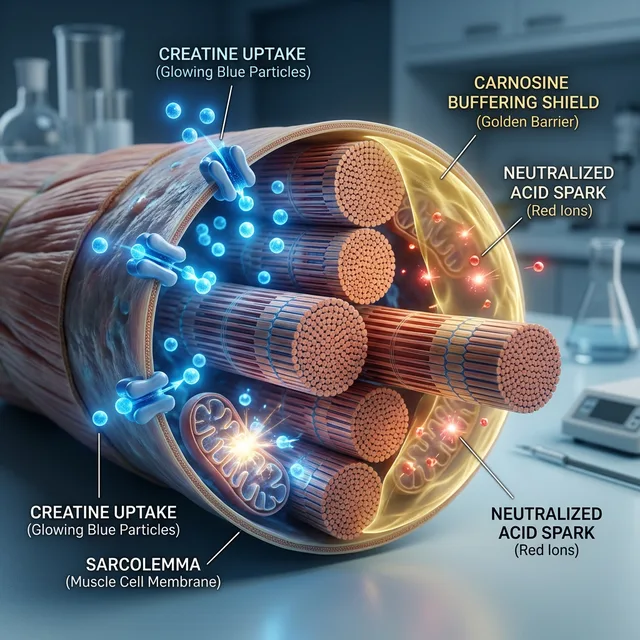
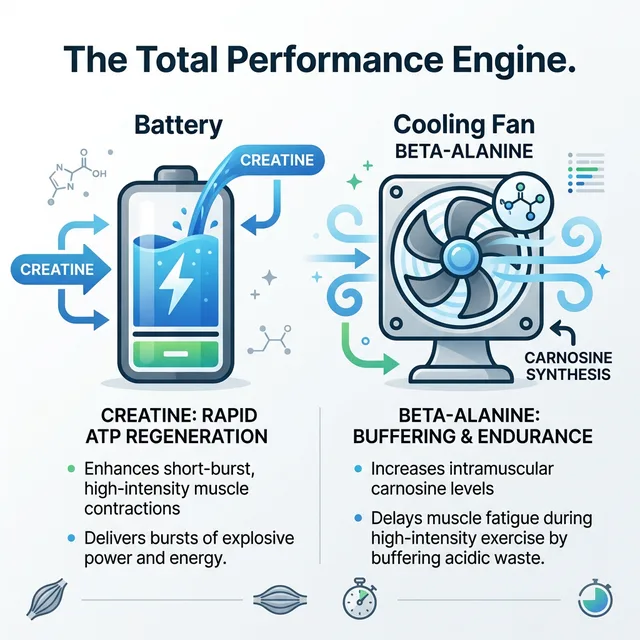
Creatine is stored in your muscles as Phosphocreatine. When you perform a high-intensity task, your body uses up ATP (Adenosine Triphosphate). Creatine "donates" a phosphate molecule to instantly turn used-up ADP back into fresh ATP.
2. Beta-Alanine: The Acid Buffer
The byproduct of that energy production is a buildup of hydrogen ions (H+), which lowers the pH of your muscles, making them acidic. This is the "burn" that makes you stop. Beta-Alanine combines with Histidine to create Carnosine, which acts like a molecular sponge, soaking up those H+ ions and keeping the cellular environment stable.
Beyond the Gym: The Neuro-Protective "Secret"
This is the part of the "Recipe" that will surprise your audience. Both of these compounds are highly active in the Brain.
- Creatine & Brain Bioenergetics: The brain is the most energy-demanding organ in the body. Research shows that Creatine supplementation can improve short-term memory and reasoning, especially in stressed or sleep-deprived individuals (like us doctors!).
- Carnosine & Glycation: Beta-Alanine boosts Carnosine, which is one of our most potent defences against Advanced Glycation End-products (AGEs). AGEs "cross-link" proteins in the brain and skin, contributing to both wrinkles and neurodegeneration. By taking Beta-Alanine, you aren't just buffering muscle acid; you are protecting your proteins from "caramelizing."
Biohacking Your Labs: What to Watch
When you start this protocol, you might notice one specific lab value "flicker":
Creatinine: In a standard blood panel, "Creatinine" is used as a marker for kidney function. Because Creatine breaks down into Creatinine, your levels may appear slightly elevated. As a general guideline: Don't panic. If your GFR (Glomerular Filtration Rate) and Cystatin-C are normal, the elevated Creatinine is simply a byproduct of your supplement, not a sign of kidney damage.
The Architect’s "Power Couple" Protocol
To get the maximum synergistic effect, you have to move past the "pre-workout" mentality. These are saturation supplements—they work over time, not instantly.
1. Creatine Monohydrate
Don't get distracted by "fancy" versions like HCL or Nitrate. Monohydrate is the most researched and effective.
- The Dosage: 5g daily. Every. Single. Day.
- The Physician’s Tip: No "loading phase" is necessary unless you are in a rush. 5g a day will saturate your muscles in about 3 weeks.
2. Beta-Alanine
- The Dosage: 3.2g to 6.4g daily.
- The "Tingle" Factor: If you hate the "pins and needles" feeling (paresthesia), split your dose into two smaller 1.6g servings, or use a sustained-release version.
- The Timing: Like Creatine, timing doesn't matter as much as consistency. You are building up a "pool" of Carnosine in your tissues.

Safety & Physician’s Cautions
While these are two of the safest supplements on the planet (with over 1,000 peer-reviewed studies), we must be diligent:
- Kidney Disease: If you have pre-existing Stage 3+ Chronic Kidney Disease, consult your specialist before starting Creatine.
- Paresthesia: The Beta-Alanine tingle is harmless—it’s just a sensory nerve reaction—but it can be startling if you aren't expecting it.
- Hydration: Creatine draws water into the muscle cell. This is great for muscle protein synthesis, but it means you must increase your daily water intake by about 500ml.
Final Physician’s Note
We tend to think of ageing as a slow fade, but at the cellular level, it’s often a "power failure." By supplementing with Creatine and Beta-Alanine, you are essentially upgrading your cellular battery and your cooling system at the same time. Whether you are lifting weights or navigating a high-stakes board meeting, you want the most efficient engine possible.
Medical Disclaimer
This information is for educational purposes and does not constitute medical advice. Consult your physician before starting any new supplement regimen, particularly if you have existing medical conditions or take prescription medications.