
By Dr. Gavin McAuley | EMPOWERVIDA
TL;DR
Caffeine wakes you up. L-Theanine stops it from making you wired. Together, they produce what researchers call "alert relaxation" — focused attention without the jitters, the crash, or that edgy restlessness. This is the most well-studied nootropic combination in existence, and it costs less than your morning latte.

The Clinical Reality of Caffeine
Caffeine is a heavily utilized and legitimate cognitive enhancer. It competitively blocks adenosine receptors, increases dopamine signalling, and sharpens reaction time. However, its clinical efficacy is highly variable and often dose- and state-dependent.
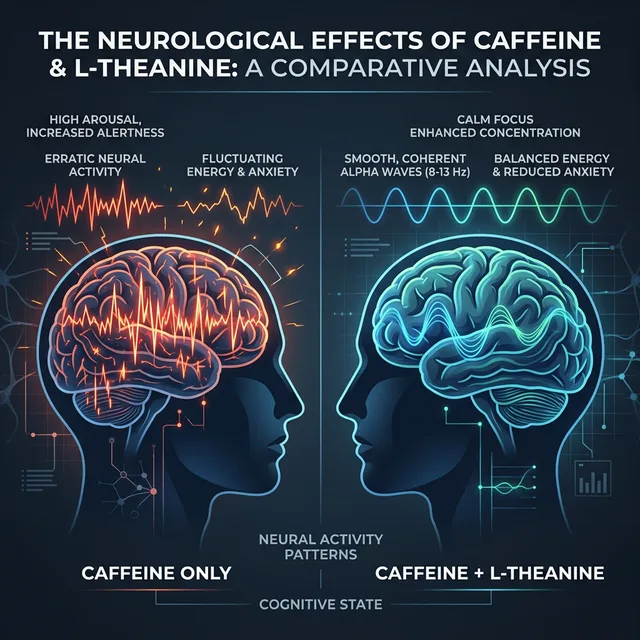
In clinical practice, individuals frequently report a paradox: while caffeine may initially increase wakefulness, it often fails to produce sustained, productive focus—particularly following sleep deprivation. Instead of "alertness," the primary physiological response becomes sympathetic nervous system overactivation, resulting in jitteriness, restlessness, and acute anxiety. The patient is "awake," but cognitively scattered.
The introduction of L-Theanine at specific clinical doses systematically alters this physiological response. When co-administered with caffeine, L-Theanine reliably mitigates the sympathetic "jitter" while preserving the cognitive arousal. It effectively converts raw nervous energy into a state of clear-headed, sustainable focus.
This synergistic interaction forms the basis of one of the most consistently recommended, evidence-based nootropic protocols in functional medicine.
The Biochemistry: Why This Actually Works
Caffeine and L-Theanine work on overlapping but distinct systems in the brain. Understanding why they're synergistic requires about 60 seconds of neuroscience:
Caffeine blocks adenosine receptors. Adenosine is the molecule that accumulates throughout the day and makes you feel sleepy. By blocking it, caffeine creates a sense of wakefulness and increases dopamine and norepinephrine activity. The downside? It also activates the sympathetic nervous system. Heart rate goes up. Cortisol spikes. Your pupils dilate. This is the "fight or flight" edge that makes some people anxious.
L-Theanine (found naturally in green tea) crosses the blood-brain barrier and increases alpha brain wave activity — the frequency associated with calm, relaxed attention. It also boosts GABA, the brain's primary inhibitory neurotransmitter, which directly counteracts the sympathetic overdrive that caffeine produces.
Think of it this way: the combination keeps the "accelerator" (caffeine) pressed while gently applying the "brake" (theanine) on the anxiety pathway. You get speed without losing control.
What the Research Actually Shows
This isn't speculative biohacking. The L-Theanine + caffeine combination is one of the most studied nootropic pairings in the published literature:
- A 2008 study in Biological Psychology found that the combination improved both speed and accuracy of attention tasks, and reduced susceptibility to distraction — better than either compound alone.
- A 2010 study in Nutritional Neuroscience confirmed significant improvements in attention switching and reduced mind-wandering with the combination.
- Multiple EEG studies have shown that L-Theanine increases alpha-wave activity within 30–40 minutes of ingestion, creating a measurable state of "relaxed alertness."
The key finding across these studies: the combination produces better cognitive performance than caffeine alone, with fewer side effects. That's a rare thing in pharmacology.
Who This Is Really For
Clinical application of this protocol is typically indicated for three primary patient profiles:
- Caffeine-Sensitive Individuals: For patients who experience anxiety, tremors, or minor palpitations from caffeine but still require cognitive enhancement, L-Theanine mitigates the sympathetic side effects while preserving focus.
- "Afternoon Crash" Phenotypes: Patients experiencing a pronounced mid-afternoon energy slump often suffer from a post-caffeine cortisol rebound. Co-administration of L-Theanine smooths the pharmacokinetic curve, preventing the abrupt crash.
- Sleep-Deprived Professionals: Following sleep restriction, isolated caffeine administration often produces a "wired but tired" state. The L-Theanine addition helps convert this sympathetic arousal into functional cognitive capacity.
The Ratio That Matters
The clinically studied ratio is 2:1 — L-Theanine to Caffeine:
200mg L-Theanine + 100mg caffeine
(the standard dose used in most clinical trials)
A standard cup of coffee contains approximately 80–120mg of caffeine. Therefore, the administration of a single 200mg L-Theanine capsule alongside morning coffee reliably achieves the targeted 2:1 ratio, providing a straightforward, highly effective clinical intervention.
Why Green Tea Already Does This (Partially)
Ever wondered why green tea feels "different" from coffee? It's not just the lower caffeine content. Green tea naturally contains L-Theanine — roughly 25–60mg per cup. This is why tea drinkers often describe a "calmer" alertness compared to coffee.
The problem is that the dose in tea is too low to fully counteract a strong coffee. You'd need 4–6 cups of green tea to match the 200mg dose used in clinical studies. Hence, supplementation.
Safety
This is one of the safest pairings Educational frameworks often suggest:
- L-Theanine has no known toxicity and no established upper tolerable limit. Doses up to 900mg/day have been studied without adverse effects.
- The only caution: at very high doses (>600mg), some people report mild drowsiness. Start with 200mg.
- If you are pregnant or breastfeeding, stick to whatever caffeine guidance your obstetrician has given you and add L-Theanine only with their approval.
- No known significant drug interactions.
Clinical Conclusion
Effective interventions in neuro-optimization do not always require complex protocols. The co-administration of L-Theanine and caffeine is highly cost-effective, supported by robust pharmacological evidence, and produces an acute, objectively measurable response within the first administration.
For individuals utilizing caffeine who experience sympathetic over-activation or struggle to convert stimulant arousal into productive focus, integrating 200mg of L-Theanine presents a highly logical, evidence-based refinement to daily cognitive maintenance.
Clinical Addendum
This content is for educational and informational purposes only. It is not intended as medical advice and should not replace consultation with a qualified healthcare professional. Always consult your physician before starting any new supplement, diet, or exercise programme.