
By Dr Gavin McAuley | EmpowerVida
An EmpowerVida health feature | Editorial review draft — not published
Standfirst: We've spent decades learning to protect our skin from the sun. Then researchers began asking whether sun avoidance could have unintended consequences. A major Australian sunscreen trial has made that question more interesting—but the answer is not what the wellness headlines would have you believe.
There is a peculiar contradiction at the centre of modern health advice. Sunlight helps our bodies manufacture vitamin D. The same ultraviolet radiation can damage DNA, accelerate skin ageing and cause cancer.
Both statements are true. Neither is particularly controversial.
Yet scroll through health media for five minutes and you might encounter two very different stories. In one, sunscreen is a daily non-negotiable. In the other, it's portrayed as the reason we're tired, miserable and deficient in a vitamin supposedly responsible for everything from mood to immunity.
It's a satisfying argument. A little too satisfying.
The more interesting story begins not with a sunscreen bottle, but with a molecule whose importance medicine has understood for generations—and whose wider effects we're still trying to untangle.
The paper that helped put vitamin D back in the spotlight
In 2007, Michael Holick published Vitamin D Deficiency in the New England Journal of Medicine. It became an influential reference in the growing discussion about vitamin D and public health.
Its central concern was legitimate. Vitamin D deficiency can undermine bone mineralisation. In children, severe deficiency can cause rickets. In adults, it can contribute to osteomalacia, with bone pain and muscle weakness. This is established medicine, not a wellness theory.
But the paper also described research suggesting vitamin D might be involved in processes far beyond the skeleton. Its possible relationships with cancer, immune function and other conditions drew considerable attention.
Here is the distinction that tends to disappear when a scientific paper becomes a social-media post: Holick's article was a review. It brought together existing research, including observational findings and biological hypotheses. It did not establish that pushing everyone's vitamin D level higher would prevent depression, cancer or cardiovascular disease.
That distinction matters because it has shaped nearly two decades of debate.
Why vitamin D isn't quite like other vitamins
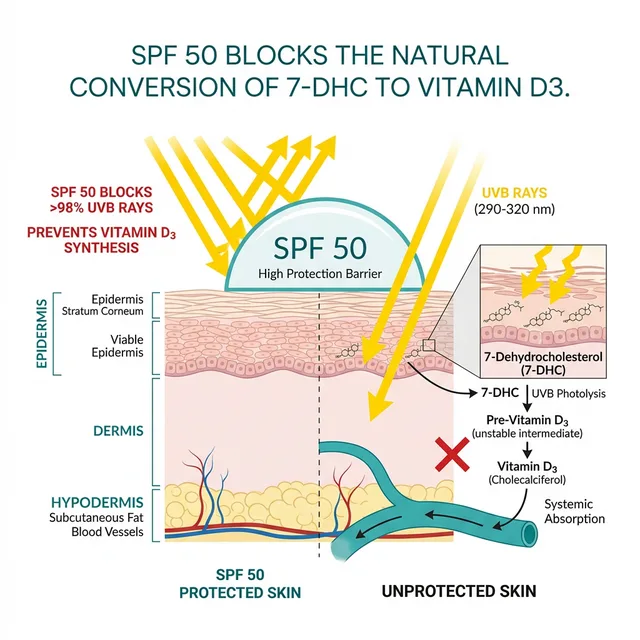
Vitamin D is unusual. We can obtain some from food, including oily fish, egg yolks and fortified products. But our skin can also make it when exposed to ultraviolet B (UVB) radiation.
That first product is processed in the liver into 25-hydroxyvitamin D—often written as 25(OH)D. This is the form typically measured in a blood test. The kidneys, and some other tissues, can then convert it into calcitriol, the active hormone.
Calcitriol helps regulate calcium and phosphate balance. Without enough vitamin D, even a calcium-rich diet may not adequately support normal bone health.
Researchers have also identified vitamin D receptors in tissues beyond the gut and bones. This includes parts of the nervous system. It's biologically intriguing. It suggests vitamin D can participate in more than one physiological system.
But a receptor is not a clinical outcome. Finding a pathway in a laboratory does not tell us whether a supplement improves how a person feels, thinks or ages.
Could vitamin D influence the brain?
This is where the science becomes genuinely fascinating.
Researchers including Darryl Eyles, Thomas Burne and John McGrath have investigated vitamin D's possible role in brain development. Their 2011 review, Vitamin D in fetal brain development, examined experimental and epidemiological evidence involving neuronal differentiation, signalling pathways and early-life development.
It's an important field, but we need to keep the context clear. Much of the mechanistic work concerns animal models, cells or prenatal development. Those findings cannot simply be converted into advice that a middle-aged adult should take large doses of vitamin D to improve concentration or prevent dementia.
The temptation to make that leap is understandable. We all like a neat biological explanation. But the brain is rarely neat.
Mood, for example, is influenced by sleep, circadian rhythms, relationships, illness, medications, physical activity and countless other factors. A single blood marker is unlikely to explain all of it.
The depression question: a clue, not a verdict
In 2013, Anglin and colleagues published a systematic review and meta-analysis examining vitamin D deficiency and depression in adults. They reported an association between lower vitamin D status and depression.
That finding deserves attention. It does not, however, answer the most important question: does low vitamin D contribute to depression, or does depression contribute to low vitamin D?
Someone experiencing depression may spend less time outdoors, exercise less or have changes in diet and routine. Chronic illness may influence both vitamin D levels and mental health. These are examples of confounding and reverse causation—two of the reasons observational studies cannot, by themselves, prove a treatment works.
Researchers have tested vitamin D supplementation for depressive symptoms. The trial literature is mixed, with differences in participants, baseline vitamin D status, doses and outcomes. It does not justify describing vitamin D as a reliable antidepressant for the general population.
Nor should we reduce seasonal affective disorder to a vitamin deficiency. Reduced daylight can affect circadian timing and sleep–wake regulation independently of vitamin D.
If someone is persistently low in mood, checking for relevant medical problems may be appropriate. But depression deserves a proper assessment and evidence-based care—not a promise that a supplement will fix it.
Then came the sunscreen question
For years, an apparently simple observation shaped the debate. UVB radiation is needed for vitamin D synthesis. Sunscreen reduces UVB reaching the skin. Surely, then, sunscreen must cause widespread deficiency.
Laboratory conditions made the theory plausible. Real life was less straightforward.
People don't apply sunscreen perfectly. They miss patches, use too little, forget to reapply or spend time outdoors before putting it on. Earlier population studies and sunscreen trials often found little effect on vitamin D status. Some of those trials, however, involved sunscreens with lower sun-protection factors than many Australians use today.
That left an important gap in the evidence.
The Australian trial that complicated the story
The Sun-D trial, published in the British Journal of Dermatology in 2025, set out to address it.
Researchers randomly assigned 639 participants to one of two groups. One group was asked to apply supplied SPF50+ sunscreen each morning on days when the forecast UV Index was at least 3. The other group used sunscreen at their own discretion.
The trial ran for approximately a year, with vitamin D measurements taken at several points.
The result? Average 25(OH)D concentrations were lower in the daily-sunscreen group. Participants assigned to regular SPF50+ use were also more likely to be vitamin D deficient at the end of the study.
That is a meaningful finding. Unlike a purely observational study, random allocation makes it easier to attribute a difference between groups to the intervention.
It also corrects an overly confident claim sometimes made in public discussion: that sunscreen simply cannot affect vitamin D levels in practice.
But this is the part worth reading twice.
The trial did not show that sunscreen causes depression. It did not test mood as its central clinical outcome, nor did it show that avoiding sunscreen improves health.
And the investigators did not conclude that Australians should abandon sun protection. They recommended continuing sunscreen use while recognising that vitamin D testing or supplementation may be appropriate for some people.
A scientifically interesting trade-off is not the same thing as a public-health reversal.
Why the Australian setting matters
Australia has one of the world's highest burdens of skin cancer. Our public-health advice about UV exposure isn't an arbitrary modern fashion; it reflects a substantial, well-established risk.
UV radiation can damage skin-cell DNA. The effects accumulate, and intense exposures can be especially harmful. Sunscreen is one part of protection, alongside shade, protective clothing, hats and sunglasses.
Cancer Council Australia recommends sun protection when the UV Index is 3 or above, as well as in circumstances involving extended exposure or other elevated risk. Advice varies with season, location and individual circumstances.
This creates a question with no universal, one-size-fits-all answer. How do we prevent UV damage while maintaining adequate vitamin D?
For many Australians, incidental exposure is sufficient. For others—particularly people who spend very little time outdoors, have darker skin, cover most of their skin, have malabsorption disorders or face other recognised risks—deficiency deserves consideration.
The solution to a low vitamin D level is not necessarily more unprotected sun. Prolonged exposure increases UV-related harm, and vitamin D production does not continue rising indefinitely with time spent outside.
This is precisely why the sensible discussion is about risk assessment, rather than a blanket instruction to seek more sun or wear less sunscreen.
The seductive idea of an 'optimal' vitamin D level
Online, you'll find confident charts dividing blood levels into categories such as deficient, adequate, optimal and exceptional. Some promise better mood, sharper thinking or longer life above a particular threshold.
It's appealing. It gives us a number to chase.
Unfortunately, medicine has not established a universal blood concentration that maximises mood, cognition or longevity.
Different organisations use different thresholds for particular clinical purposes. In Australia, vitamin D is commonly reported in nmol/L; US sources often use ng/mL. To convert ng/mL to nmol/L, multiply by 2.5.
Those units matter, but the larger point matters more: a higher result is not automatically a better result.
In 2024, the Endocrine Society published updated guidance on vitamin D for disease prevention. For generally healthy adults without an established indication for testing or treatment, it advised against routine 25(OH)D screening. It also did not endorse a specific blood-level target for preventing the broad range of diseases often associated with low vitamin D in observational studies.
The guideline makes distinctions by age and clinical circumstances. It is not an argument that deficiency should be ignored.
It is an argument against turning every healthy person into a patient simply because a number could be measured.
Do we need vitamin D supplements—and what about K2 and magnesium?
This is another area where a reasonable idea can become an elaborate supplement ritual.
Vitamin D supplements have clear uses. People with documented deficiency or certain medical conditions may benefit, and some groups have specific preventive recommendations. But the appropriate approach depends on the person.
Vitamin D3 is commonly used, and vitamin D2 is also a recognised form. Neither requires a universal add-on package to 'work'.
Vitamin K has an important role in proteins involved in blood clotting and bone biology. That does not establish that everyone taking D3 needs K2 to prevent calcium from accumulating in their arteries. The evidence does not support making that promise.
Magnesium participates in numerous enzymatic processes, including aspects of vitamin D metabolism. But it would be misleading to say vitamin D supplements become inactive unless everyone also takes magnesium. Treat an actual magnesium deficiency when indicated; don't assume one exists.
And more vitamin D is not necessarily harmless. Excessive supplementation can lead to hypercalcaemia, kidney complications and other adverse effects. Daily doses of 4,000–5,000 IU should not be casually recommended to every reader.
The practical question isn't 'What's the biggest supplement stack I can take?' It's 'Do I have a reason to suspect deficiency, and what is the safest way to address it?'
The opportunity: what sunlight science can teach us about healthier living
There is something genuinely encouraging about the vitamin D story. A molecule made in our skin under the influence of sunlight has become a window into bone biology, immune signalling and questions about the developing brain. The Australian Sun-D trial shows that even familiar public-health advice can be refined by new evidence.
That is progress. It means our understanding can become more precise without requiring us to choose between protecting our skin and caring about vitamin D.
The bigger opportunity is to think about health as a connected system. Time outdoors can support physical activity, time in nature and regular daily routines. Daylight is an important signal for the body's circadian clock. These benefits should not be confused with proof that extra UV exposure—or a higher vitamin D blood level—treats depression.
Your next move: practical steps worth taking now
Keep sun protection in the picture. In Australia, UV exposure can be intense. Follow Cancer Council guidance, including protection when the UV Index is 3 or above, rather than chasing vitamin D through deliberate sunburn or prolonged unprotected exposure.
Build a healthy daylight routine. Regular outdoor walks and a consistent sleep–wake schedule can be worthwhile for many reasons, including movement and circadian regularity. You do not need to abandon sunscreen to benefit from time outdoors.
Know when vitamin D deserves a closer look. If you have osteoporosis, malabsorption, limited sun exposure or another recognised risk factor, discuss assessment and treatment with a clinician. Targeted testing and supplementation can be useful when indicated; neither is a universal longevity requirement.
Think beyond one blood test. Mood, fatigue and cognitive symptoms deserve a proper assessment. A vitamin D result alone cannot explain them.
What to watch next
The exciting questions are becoming more specific: who is most likely to develop deficiency, how do everyday sun-protection behaviours affect vitamin D status over time, and which outcomes actually improve when deficiency is corrected?
Better trials will help separate biological plausibility from measurable benefit. That's the kind of research worth following—not because it promises a miracle, but because it may give people more confident, individualised choices.
The most hopeful conclusion is not that sunlight is a cure or sunscreen is the enemy.
It's that we can protect our skin, address genuine deficiency and keep learning how daylight, behaviour and biology fit together. Good longevity medicine should make life more liveable—not more frightening.