
The Quick Summary (TL;DR)
- The Form Matters: Standard CoQ10 (Ubiquinone) requires an internal enzymatic conversion that dramatically slows down after age 40.
- The Solution: Ubiquinol may offer significantly better absorption for those over 40, as the conversion from Ubiquinone becomes less efficient with age.
- The Hack: Always take it with dietary fat (avocado, olive oil) to ensure it reaches your bloodstream.
Throughout clinical fields—from acute care to general practice—I’ve seen the systemic consequences of cellular energy failure. In longevity medicine, our goal is to optimize that energy long before the system breaks down.
Usually, the first thing people reach for is CoQ10. It’s the darling of the longevity world, and for good reason. But there’s a nuance here that most people (and even some of my colleagues) miss. It’s not just about taking the supplement; it’s about whether your body can actually use the "currency" you’re giving it.
This brings us to the great debate: Ubiquinone vs. Ubiquinol.
The Mitochondrial Electron Transport Chain (ETC)
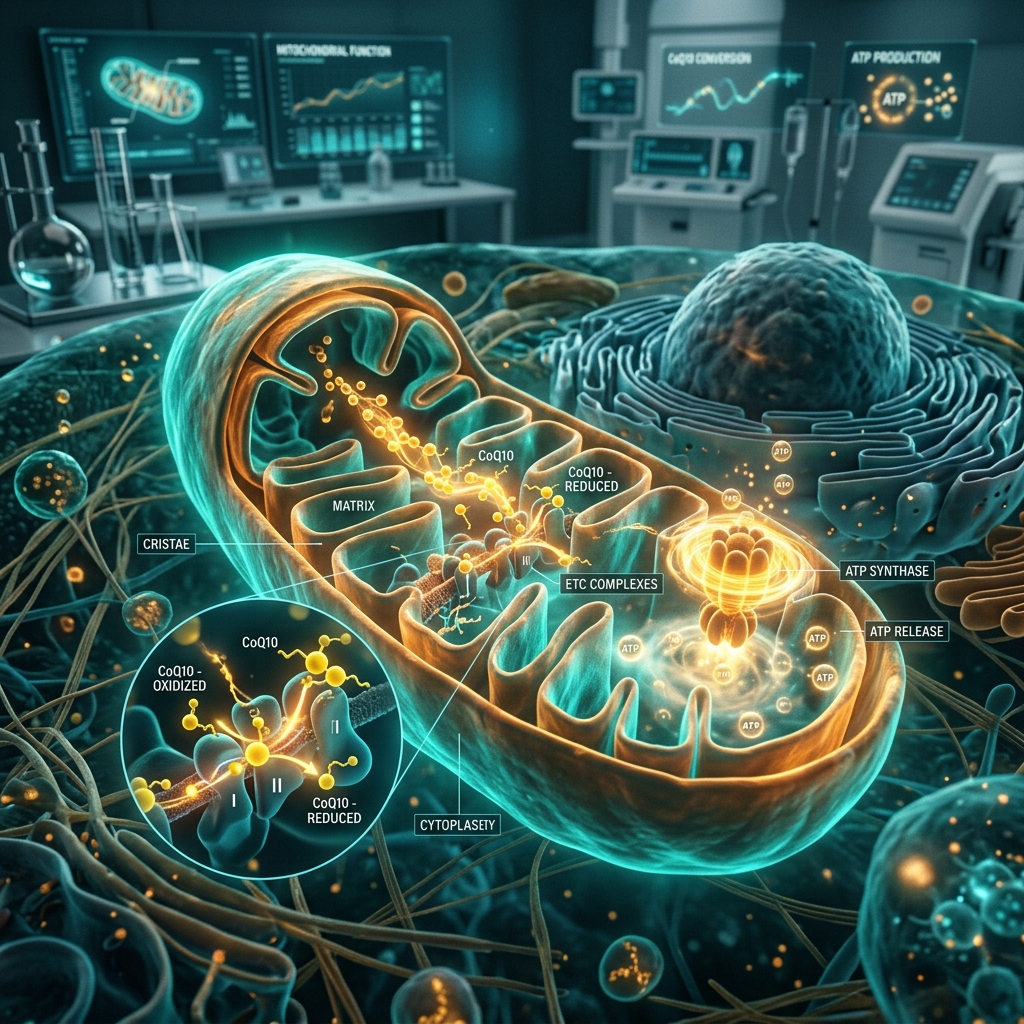
To appreciate why CoQ10 is vital, we must look at how our cells generate power. Inside the inner mitochondrial membrane, the Electron Transport Chain (ETC) acts as a high-speed electrical circuit. Electrons derived from the food we eat are passed down a chain of specialized protein complexes (Complex I, II, III, and IV). This electron flow powers the pumping of protons, creating an electrochemical gradient that drives the enzyme ATP synthase to churn out adenosine triphosphate (ATP)—the fundamental energy currency of human life.
CoQ10 is the critical, mobile link in this chain. It acts as an electron shuttle, collecting electrons from Complex I and Complex II and carrying them to Complex III. If CoQ10 levels are deficient, the entire transport chain slows to a crawl, and cellular ATP production crashes. More dangerously, blocked electrons begin to leak out of the respiratory chain. These stray electrons react with local oxygen molecules to form superoxide radicals and other Reactive Oxygen Species (ROS). This is cellular "soot"—a highly destructive byproduct that causes oxidative damage to the mitochondrial membrane, proteins, and the mitochondria's own vulnerable DNA (mtDNA), accelerating the cellular aging process from within.
The "Currency" Problem
Think of your mitochondria—the tiny power plants inside your cells—as needing a specific type of fuel to produce ATP (energy). CoQ10 is that fuel. However, it exists in two states:
- Ubiquinone: The oxidized form. Think of this as an "un-filled" battery.
- Ubiquinol: The reduced, active form. This is the "fully charged" battery ready to donate electrons.
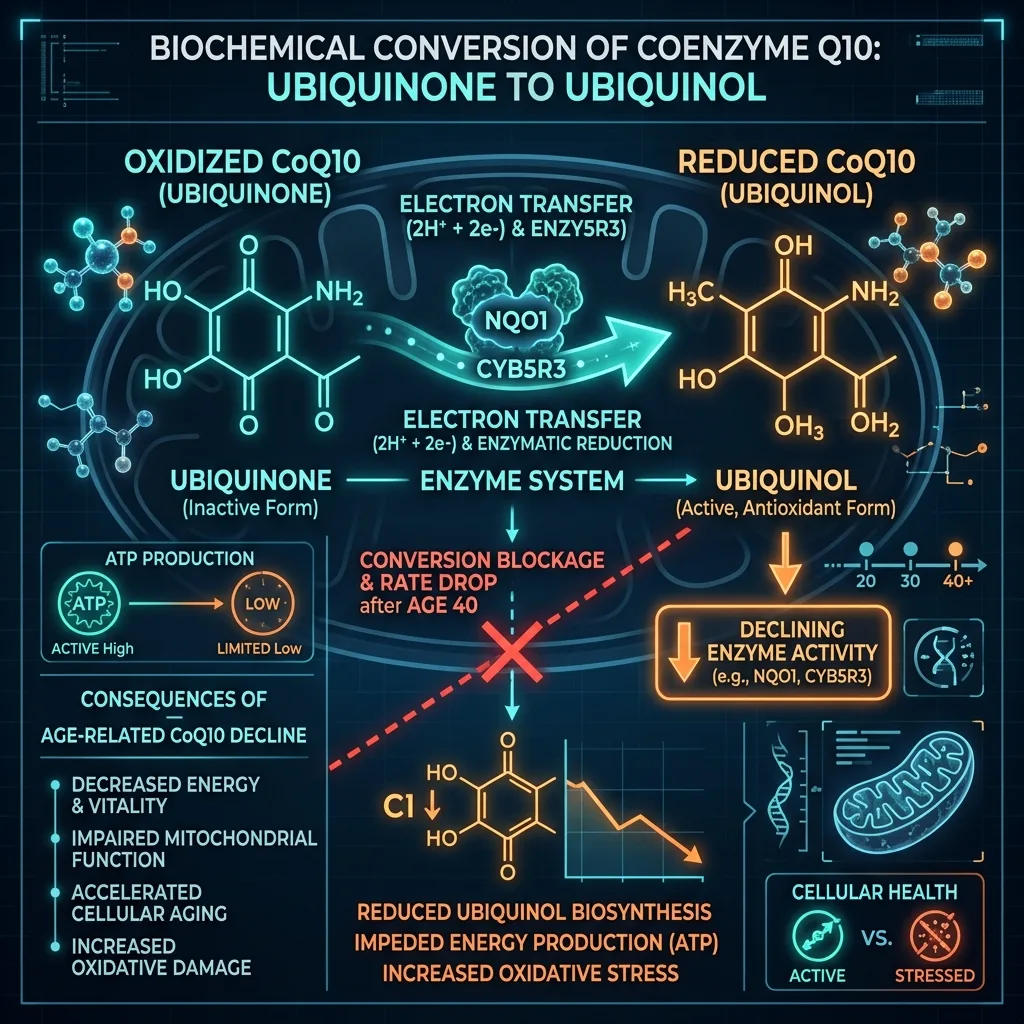
When you swallow a standard CoQ10 (Ubiquinone) capsule, your body has to work to convert it into Ubiquinol before it can do a single thing for your heart or your brain.
The Age Gap: When the Conversion Stops
When we’re 20, our bodies are conversion machines. We take Ubiquinone and flip the switch to Ubiquinol with ease. But as a Family Physician, I’m rarely treating 20-year-olds for longevity.
As we cross the 40-year-old threshold, or if we are dealing with the "physiological overhead" of chronic stress or inflammation, that conversion process slows down. We become less efficient. This conversion relies on specific enzyme pathways—primarily NAD(P)H:quinone oxidoreductase 1 (NQO1) (often called diaphorase). As we cross the 40-year-old threshold, or if we are dealing with the metabolic "overhead" of chronic stress, subclinical inflammation, or toxic burden, the expression and activity of NQO1 drop significantly. Genetic polymorphisms (common variations in the NQO1 gene) can also severely impair your conversion baseline. Furthermore, chronic stress depletes the cellular pools of NAD(P)H, which acts as the essential cofactor for this reduction process. If you lack the cofactors or the enzymes, you cannot convert Ubiquinone. You are essentially paying for expensive "tourist" molecules that pass through your digestive system without ever donating a single electron to your respiratory chain.
What the Science Actually Says
We often look to landmark studies in the journal Mitochondrion to understand this shift. Research has consistently shown that Ubiquinol maintains much higher plasma levels compared to the same dose of Ubiquinone.
In one foundational clinical trial, older adults supplementing with Ubiquinol demonstrated significantly better plasma absorption compared to those on the standard Ubiquinone form. This difference in bioavailability reflects a meaningful consideration in how we approach mitochondrial support.
The Statin Drain: A Crucial Clinical Intersect
For anyone on a cardiovascular optimization protocol, there is another major biochemical factor to consider: statin therapy. Statin medications are exceptionally effective at reducing cardiovascular risk by inhibiting HMG-CoA reductase, the rate-limiting enzyme in the liver's mevalonate pathway used to synthesize cholesterol.
However, this mevalonate pathway is not just a cholesterol factory—it is also the identical pathway the human body uses to synthesize CoQ10. By shutting down HMG-CoA reductase, statins block the production of mevalonate, which subsequently starves the body's ability to produce CoQ10. Clinical studies show that statin therapy can drop circulating CoQ10 levels by 40% to 50% within weeks. This depletion is a primary driver of statin-associated muscle symptoms (SAMS), such as myalgias, cramps, and profound systemic fatigue. For individuals on statins, supplementing with pre-converted Ubiquinol is a critical clinical countermeasure. By bypassing the liver's blocked mevalonate pathway and the age-dependent conversion process, Ubiquinol directly restores mitochondrial electron transport in cardiac and skeletal muscle tissue, resolving myalgias and preserving muscular cellular energy.
Evidence-Based Considerations
When evaluating a Ubiquinol supplement, the Kaneka Ubiquinol™ seal is widely regarded as a benchmark for stability and purity. Evidence-based guidance generally considers the following:
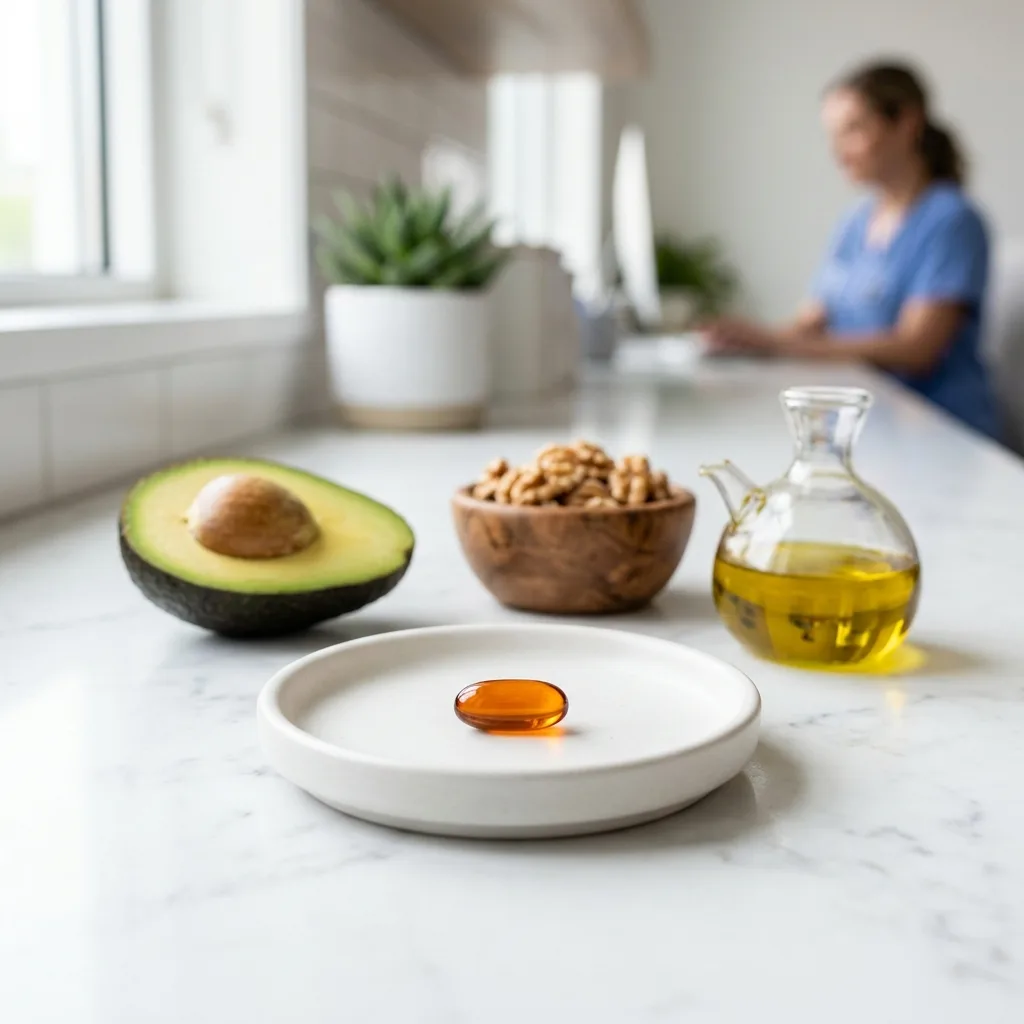
- Absorption with Fat: CoQ10 is lipophilic (fat-loving). Taking it with a meal containing healthy fats—such as avocado, olive oil, or eggs—supports absorption. Taking it on an empty stomach may reduce uptake significantly.
- Dosage: Clinical protocols vary; consult your healthcare provider to determine an appropriate dose for your individual circumstances.
- Potential Synergies: PQQ is sometimes studied alongside CoQ10 for its role in mitochondrial biogenesis. Discuss any combined supplementation with a qualified practitioner.
- Clinical Monitoring: While testing blood levels of CoQ10 is possible, it only measures circulating plasma levels, not intracellular mitochondrial concentrations. To evaluate mitochondrial efficiency clinically, physicians look at urinary organic acid panels, tracking specific biomarkers like succinate, fumarate, and the lactate-to-pyruvate ratio. Elevated levels of these intermediates indicate enzymatic bottlenecks in the Krebs cycle or the electron transport chain, suggesting a need for mitochondrial cofactors.
The Bottom Line
Don't let your supplement cabinet be a graveyard of good intentions. If the goal is vibrant aging and sustained mental clarity, we have to respect the biochemistry. Switch to Ubiquinol. Your mitochondria will thank you.
An Educational Framework
Ready to stop guessing with isolated supplements and optimize your mitochondrial grid from the ground up?
Explore The Energy & Vitality Stack →About the Author
Dr. Gavin McAuley is a Medical Doctor with a diverse clinical background spanning Emergency Medicine, General Practice, and several other medical specialties. As the founder of EmpowerVida and the Clinical Vitality Engineering protocols, he blends his broad diagnostic experience with precision longevity science to help high-performers optimize their metabolic health, eliminate brain fog, and build a resilient, disease-resistant cellular foundation.
Medical Disclaimer: The content provided in this post is for educational purposes only and does not constitute medical advice, diagnosis, or treatment. Always seek the advice of your physician or other qualified health provider with any questions you may have regarding a medical condition or supplement regimen.
Authoritative References
- Bioavailability Comparison: Evans, M., et al. (2013). "A randomized, double-blind, cross-over trial comparing the bioavailability of ubiquinol and ubiquinone." Journal of Functional Foods.
- Mitochondrial Health & Aging: Hernández-Camacho, J. D., et al. (2018). "Coenzyme Q10 Supplementation in Aging and Disease." Frontiers in Physiology.
- Statin-Induced Depletion: Qu, H., et al. (2018). "Effects of Coenzyme Q10 on Statin-Induced Myopathy: A Meta-Analysis of Randomized Controlled Trials." Journal of the American Heart Association.