
By Dr. Gavin McAuley | EMPOWERVIDA
The short answer: Your NAD+ levels crash as you age. This molecule powers over 500 reactions in your body. When it drops, everything breaks. And you can restore it.
In modern life, chronic exhaustion is often normalized as "part of the job." High-stress professionals manage complex decisions on minimal sleep, relying on caffeine and cortisol while their brains are screaming for glucose, only to go home and collapse.
Many individuals present with a cluster of metabolic symptoms: significant weight gain, severe afternoon brain fog, and disrupted sleep architectures. Even with secondary diagnoses addressing focus issues, the profound, unyielding fatigue points directly to cellular energy deficits.
Standard blood work often returns as "fine" and thyroid panels appear "normal," leaving patients to simply push through. But they aren't just tired. Their mitochondria are frequently cellularly bankrupt.
The Aging Tax
Imagine youre 20 years old. You walk into the cellular bank, and your account is flush. Youve got all the currency you need to repair DNA, power your mitochondria, and keep your brain sharp.
That currency is called NAD+ (Nicotinamide Adenine Dinucleotide).
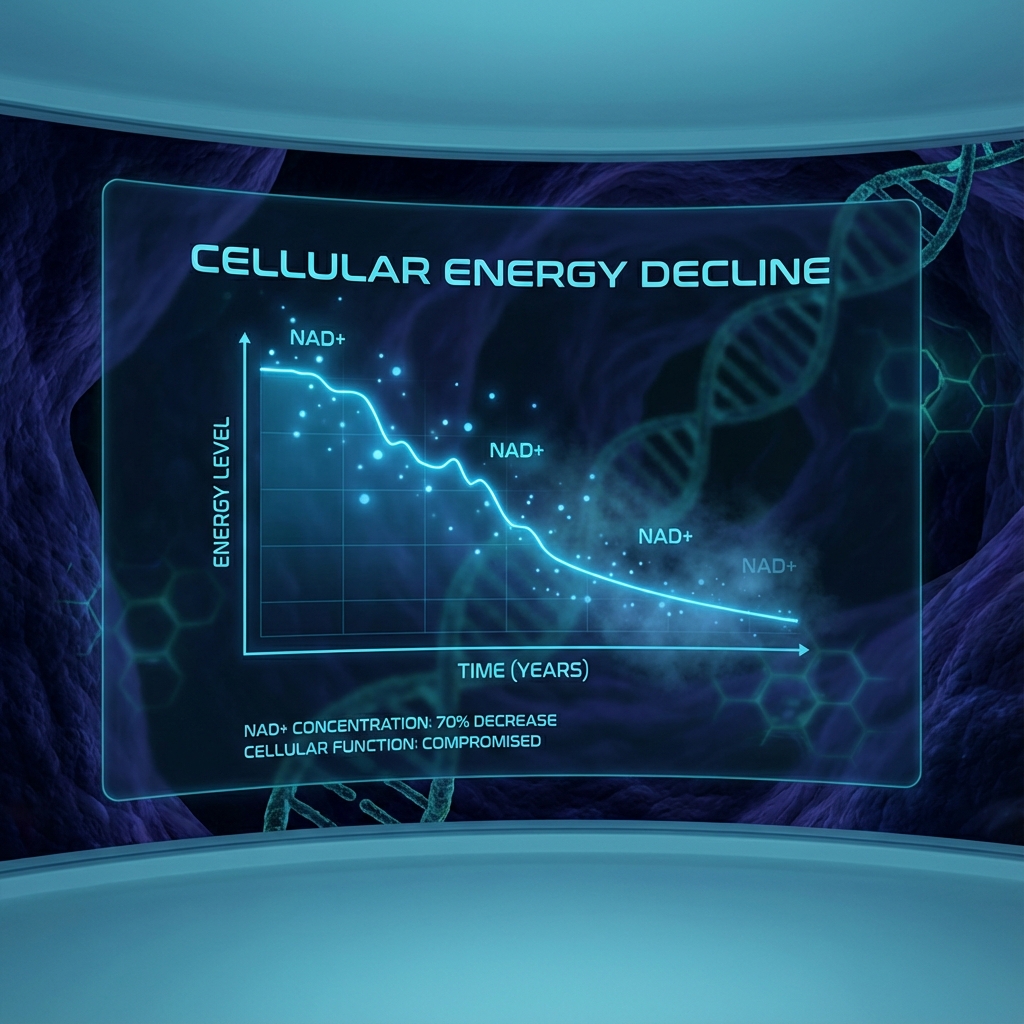
Now fast forward to 40. Half your money is gone. By 50, youre down to 30%. By 60, youre living on 10 to 20% of what you had at 20.
This isnt a metaphor. This is the biological reality of aging. NAD+ fuels over 500 enzymatic reactions including DNA repair, mitochondrial function, and your longevity genes (sirtuins).
When NAD+ drops, everything breaks down. Your brain cant focus (hello, late onset ADHD). Your body cant recover (hello, chronic fatigue). Your cells cant repair themselves.
The Focus Connection
In clinical practice, it is common to see individuals relying entirely on stimulants to maintain focus. However, when the brain runs out of NAD+, it inherently shuts down the most energy-expensive systems first: focus, willpower, and executive function.
The prefrontal cortex is the most metabolically demanding region of the brain. When NAD+ drops, cognitive stamina goes offline. This is why many adults report worsening cognitive fatigue as they age. It is not just a psychological issue; it is a metabolic one.
When patients begin to support their cellular NAD+ levels, they frequently report that cognitive fog lifts. Not overnight, but gradually, as the bioenergetic capacity of their neurons is restored.
The Educational Protocol
Restoring cellular energy is not achieved through willpower; it is achieved through a structured bioenergetic protocol.
1. Lifestyle first. Regular exposure to nature, such as forest walks and ocean swims, are not just recreational. They are potent stress modulators. They lower cortisol, which in turn preserves the body's NAD+ pools.
2. The foundation stack. Creatine (5g daily) and CoQ10 (200mg daily). These support ATP production and foundational mitochondrial function.
3. NAD+ precursors. Supplementation with NR (nicotinamide riboside), typically 300mg daily in the morning, is highly effective. NR is supported by over 20 human trials, is chemically stable, and holds FDA GRAS status.
The Educational Perspective
The path to reversing metabolic distress is not simply about willpower; it requires a systemic approach to restoring cellular machinery.
At the end of the day, aging isnt inevitable decline. Its a loss of cellular currency. NAD+ is the master regulator of energy, repair, and longevity. When it drops, everything breaks down. When you restore it, you restore function.
This isnt anti aging hype. Its cellular economics.
You can do this too.
Clinical Addendum: Systemic Inflammation & Longevity
A critical component of this physiological mechanism is the role of systemic inflammation. In acute scenarios—such as a sprained ankle or a viral infection—inflammation is a life-saving biological response. Your immune system deploys white blood cells and cytokines to the site of injury to isolate the damage and initiate repair. Once the threat is neutralized, the inflammation subsides.
However, the modern lifestyle has hijacked this system. Due to diets high in ultra-processed seed oils, chronic psychological stress, sleep deprivation, and environmental toxins, our immune systems are locked in a state of perpetual high-alert. This is known as chronic, low-grade systemic inflammation.
Unlike acute inflammation, this chronic state is silent and destructive. It doesn't cause a fever or a swollen joint; instead, it slowly degrades your tissue architecture over decades. Circulating inflammatory cytokines like IL-6 and TNF-alpha physically damage the endothelial lining of your blood vessels, leading to arterial plaque formation. They cross the blood-brain barrier, triggering neuro-inflammation that manifests as severe brain fog and cognitive decline. They even bind to insulin receptors, causing insulin resistance and pushing your body toward metabolic syndrome.
To achieve true longevity, you must aggressively extinguish this slow-burning fire. This requires a comprehensive approach to "Inflammaging." It means aggressively managing your blood glucose levels, optimizing your circadian rhythm to ensure deep, restorative sleep, and utilizing potent natural anti-inflammatories like high-dose EPA/DHA Omega-3s and highly bioavailable Curcumin extracts to interrupt the inflammatory cascades at the molecular level. Healthspan is ultimately dictated by how well you can control inflammation.
Clinical Addendum: The Architecture of Sleep
All the interventions we have discussed are completely nullified if you fail to optimize the foundation of human performance: sleep architecture. It is common to observe many individuals spending thousands on peptides and advanced therapies, yet they are chronically sleep-deprived. You cannot out-supplement poor sleep.
Sleep is not a passive state of unconsciousness. It is a highly active, metabolically demanding period of systemic repair. During the initial stages of deep, slow-wave (Delta) sleep, your pituitary gland releases massive surges of Human Growth Hormone (HGH), which is responsible for repairing muscle tissue, strengthening bones, and mobilizing stored fat. Simultaneously, your brain physically shrinks to allow cerebrospinal fluid to power-wash metabolic waste away through the glymphatic system.
During the later stages of REM sleep, your brain consolidates memories, processes emotional trauma, and rebuilds the synaptic networks required for learning and neuroplasticity. When you cut your sleep short by even 90 minutes, you disproportionately rob your brain of this critical REM phase.
Most adults are not actually sleeping; they are simply sedated. Alcohol, prescription sleep aids, and chronic stress fragment your sleep architecture, preventing you from ever reaching these restorative stages. To support healthy biological aging, you must treat sleep as a clinical intervention. This means respecting your circadian biology: viewing morning sunlight to set your cortisol rhythm, avoiding blue light 90 minutes before bed, dropping your core body temperature, and utilizing targeted compounds like Magnesium Bisglycinate to facilitate the transition into deep sleep.
Clinical Addendum
This content is for educational and informational purposes only. It is not intended as medical advice and should not replace consultation with a qualified healthcare professional. Always consult your physician before starting any new supplement, diet, or exercise programme.