
By Dr. Gavin McAuley | EMPOWERVIDA
The short answer: Your fasting glucose can be "normal" while your metabolism is silently collapsing. The test that reveals the truth? Fasting insulin. Most doctors dont order it.
Let me tell you about the most dangerous word in medicine: Normal.
In clinical practice, it is common to evaluate patients who are entirely exhausted, surviving on high cortisol and caffeine, yet their fasting glucose and HbA1c tests return as perfectly "normal." Despite these reassuring lab results, their underlying metabolic machinery is deeply compromised.
That is because, on a cellular level, their energy production had stalled.
The Hidden Decade
Here is what is frequently underemphasized in standard medical training: insulin rises years, sometimes decades, before fasting glucose does.
The pancreas floods the bloodstream with insulin to force glucose into resistant cells. But standard blood work only looks at the glucose, which appears "normal."
By the time glucose finally rises to the point of a clinical diagnosis, the metabolic engine has been grinding for years. This represents a massive missed clinical opportunity. We can catch this much earlier.
Insulin Resistance is a Safety Protocol
Most people think insulin resistance is a broken lock. The key (insulin) doesnt fit the door (cell receptor) anymore.
Wrong.
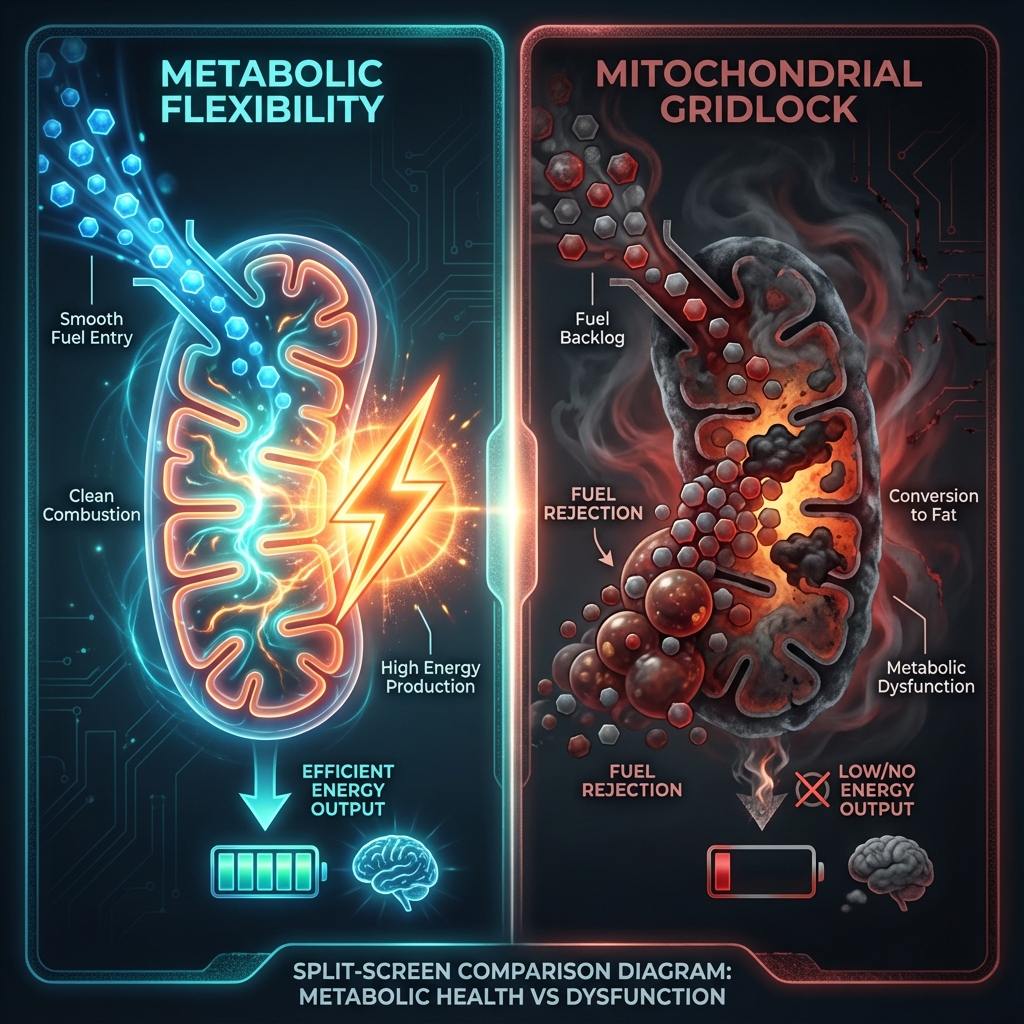
Insulin resistance is not a malfunction. Its a safety protocol. Your cells are saying "no more fuel, we cant process what weve already got."
Think of your mitochondria as factory turbines. Years of processed food, chronic stress, and sedentary living have clogged them. They cant burn fuel fast enough, so they slam the doors shut to prevent overflow damage.
The problem isnt the locked door. The problem is the overwhelmed machinery behind it.
What High Insulin Does to Your Body
When insulin stays chronically elevated (hyperinsulinemia), it reaches far beyond blood sugar:
- Fat cells: High insulin locks down fat storage. You literally cannot burn fat. You could starve yourself, and the fat stays locked away.
- Kidneys: High insulin tells your kidneys to retain sodium and water. This is why "unexplained" high blood pressure is often just a symptom of high insulin.
- Brain: High insulin blocks the leptin signal that tells you youre full. Youre hungry even though you have plenty of fuel.
This is why willpower fails. Youre not lazy. Your engine is seized.
A Clinical Approach to Sustainable Fat Loss
Before discussing targeted supplementation, here is the foundational protocol that actually shifts metabolic markers:
Clinical Addendum: The Architecture of Sleep
All the interventions we have discussed are completely nullified if you fail to optimize the foundation of human performance: sleep architecture. It is common to observe many individuals spending thousands on peptides and advanced therapies, yet they are chronically sleep-deprived. You cannot out-supplement poor sleep.
Sleep is not a passive state of unconsciousness. It is a highly active, metabolically demanding period of systemic repair. During the initial stages of deep, slow-wave (Delta) sleep, your pituitary gland releases massive surges of Human Growth Hormone (HGH), which is responsible for repairing muscle tissue, strengthening bones, and mobilizing stored fat. Simultaneously, your brain physically shrinks to allow cerebrospinal fluid to power-wash metabolic waste away through the glymphatic system.
During the later stages of REM sleep, your brain consolidates memories, processes emotional trauma, and rebuilds the synaptic networks required for learning and neuroplasticity. When you cut your sleep short by even 90 minutes, you disproportionately rob your brain of this critical REM phase.
Most adults are not actually sleeping; they are simply sedated. Alcohol, prescription sleep aids, and chronic stress fragment your sleep architecture, preventing you from ever reaching these restorative stages. To support healthy biological aging, you must treat sleep as a clinical intervention. This means respecting your circadian biology: viewing morning sunlight to set your cortisol rhythm, avoiding blue light 90 minutes before bed, dropping your core body temperature, and utilizing targeted compounds like Magnesium Bisglycinate to facilitate the transition into deep sleep.
Clinical Addendum: The Mitochondrial Connection
To fully understand the gravity of this protocol, we must look at the cellular level. Every biological function we've discussed ultimately relies on mitochondrial output. Mitochondria are the microscopic power plants inside your cells, responsible for converting the food you eat and the oxygen you breathe into ATP (Adenosine Triphosphate)—the universal energy currency of the human body.
When you experience symptoms like brain fog, chronic joint pain, or afternoon fatigue, traditional medicine often treats these as separate diseases. In longevity medicine, we view them as different downstream expressions of the exact same upstream problem: Sub-clinical Mitochondrial Dysfunction.
As we age, our mitochondria undergo structural decay. The phospholipid membranes that protect them become rigid, and they begin to leak free radicals (Reactive Oxygen Species) into the cell. This creates a state of chronic oxidative stress. Your immune system responds to this cellular damage by triggering systemic inflammation. This is the mechanism behind "Inflammaging"—the age-related increase in systemic inflammation that drives nearly every chronic disease.
Therefore, any protocol designed to optimize your healthspan must actively protect and regenerate these power plants. This is why the foundational pillars of our practice rely on specific interventions: Zone 2 Cardiovascular Training to force mitochondrial biogenesis (the creation of new mitochondria), Time-Restricted Eating to trigger mitophagy (the clearance of dead mitochondria), and targeted supplementation like NAD+ precursors and high-dose Omega-3s to provide the raw biological materials for cellular repair.
You cannot medicate your way out of mitochondrial dysfunction. You must systematically rebuild the architecture of your cells. This is the difference between simply masking symptoms and fundamentally improving the foundational markers of your biological age.
The Foundation (Non Negotiable)
- Diet: Eliminated refined carbs (bread, pasta, rice, potatoes). Drastically reduced processed foods. No supplement compensates for a broken diet.
- Exercise: Zone 2 cardio (180+ minutes per week) and strength training (3x per week). Movement is medicine.
- Post meal walks: 10 to 15 minutes after every meal. This simple habit flattens glucose spikes more effectively than most drugs.
The supplements below supported this foundation. They did not replace it.
The Support Stack
- Creatine (5g daily): Not just for gym bros. Its the rapid response fuel that keeps your cellular gears spinning.
- CoQ10 / Ubiquinol (100 to 200mg daily): The lubricant that allows electrons to slide through your mitochondria without friction.
- GlyNAC (Glycine 2g + NAC 1.2g daily): Restores glutathione. Think of it as the degreaser that washes the metabolic grit out of your engines.
- Berberine (500mg 2x daily): A potent botanical compound that acts as a natural glucose disposal agent.
The Test You Should Ask For
Next time youre at the doctor, ask for a fasting insulin test. Not just glucose. Not just HbA1c. Fasting insulin.
Optimal is below 5 mU/L. Acceptable is below 10. If youre above 15, your engine is already struggling even if your glucose looks fine.
Standard medicine often waits for the river to back up before intervening. Proactive longevity medicine evaluates the factory turbines smoking years earlier.
The Educational Perspective
Restoring metabolic health requires a foundational approach: degreasing the cellular engine and reversing systemic inflammation.
If youre tired, foggy, and gaining weight despite "doing everything right," your engine might be seized. Get the test your doctor isnt ordering.
Fix the engine. The rest follows.
Clinical Addendum
This content is for educational and informational purposes only. It is not intended as medical advice and should not replace consultation with a qualified healthcare professional. Always consult your physician before making changes to your diet, exercise, or supplement regimen.