
By Dr. Gavin McAuley | EMPOWERVIDA
TL;DR
If you feel exhausted despite eating well and sleeping 8 hours, your "ignition" system might be broken. The Methylation Cycle is the biochemical gear that turns nutrients into usable energy. Nearly 40% of people carry an MTHFR genetic mutation that severely limits this process. Taking cheap, synthetic B-vitamins (Cyanocobalamin, Folic Acid) acts like rust in these gears. The solution? Switch to "pre-methylated" active B-vitamins to bypass the genetic block and restore cellular energy.

The Physician’s Note: The Engine That Won't Start
As a clinician, one of the most frustrating puzzle boxes I see is the patient who does everything "right." They exercise, they eat organic, they sleep, yet they complain of deep, bone-weary fatigue and relentless brain fog. They feel like a sports car that just won't turn over.
In clinical practice, the transition from synthetic B-vitamins to activated forms frequently yields a noticeable difference in An individual's baseline cognitive clarity and vitality. What is often frustrating in modern medicine is that the biochemistry of B-vitamin cofactors—the very molecules that power every methylation reaction in the body—is rarely emphasized in standard pharmacological training. Many individuals receive prescriptions for fatigue or low mood before any practitioner evaluates their homocysteine levels or checks for genetic methylation roadblocks. That is the gap this article addresses.
When we map their genetics and deeply analyse their blood work, we frequently find the culprit hiding in plain sight: an "Ignition Failure" at the cellular level. Biochemically, we call this the Methylation Cycle.
What is Methylation?
Methylation is arguably the most critical biochemical process you have never heard of. It happens over a billion times a second in every cell of your body.
To put it simply, methylation is the process of passing a "methyl group" (one carbon atom and three hydrogen atoms: CH3) from one molecule to another. Think of the methyl group as a spark plug. When it attaches to a molecule, it "turns on" an engine. It tells DNA whether to express a gene or silence it. It tells the body to clear out toxins. It tells the brain to produce neurotransmitters like dopamine and serotonin.
Without efficient methylation, your cellular engines stall. You cannot convert the food you eat into the ATP energy you need to think, move, and thrive.
The Genetic Roadblock: The MTHFR Mutation
Here is the catch: to create these vital "spark plugs," your body relies heavily on an enzyme called MTHFR (Methylenetetrahydrofolate reductase).
Recent genetic data shows that approximately 40% of the population carries a mutation in this specific gene. If you have this mutation, your ability to convert the nutrients you consume (specifically Folate and Vitamin B12) into their active, methylated forms is severely compromised.
You can eat all the spinach and kale in the world, but if your MTHFR enzyme is broken, your body cannot convert that raw folate into the "Active Methylfolate" it needs to run the engine. You are pouring premium gasoline into a car with a blocked fuel line.
The Toxic Exhaust: Homocysteine
When the methylation cycle breaks down, it creates a toxic byproduct called Homocysteine.
In a healthy methylation cycle, homocysteine is cleanly recycled back into a harmless amino acid (methionine) or converted into your body's master antioxidant (glutathione). But when you lack active B-vitamins, the gears grind to a halt. Homocysteine backs up and spills into your bloodstream.
High homocysteine levels are highly neurotoxic. It acts like sandpaper inside your blood vessels, leading to chronic inflammation, an exponentially higher risk of cardiovascular events, and accelerated cognitive decline. Whenever I see An individual with unexplained fatigue and joint pain, the first blood marker I check is Homocysteine.
The "Rusty Gear": Why Cheap Supplements Make It Worse
If you look at the back of a standard, cheap multivitamin from the pharmacy, you will almost certainly see these two ingredients: Folic Acid and Cyanocobalamin.
These are cheap, synthetic versions of Vitamin B9 and B12. They are not biologically active. To use them, your body has to force them through the MTHFR enzyme. But if you have the mutation, your body can't clear them.
unmetabolised synthetic Folic Acid actually blocks the receptor sites on your cells, preventing the tiny bit of real, natural folate from getting in. Taking synthetic B-vitamins when you have a methylation issue is like pouring sand into a struggling gearbox. It makes the fatigue and brain fog actively worse.
The Physician’s Protocol: The "Methylated Bypass"
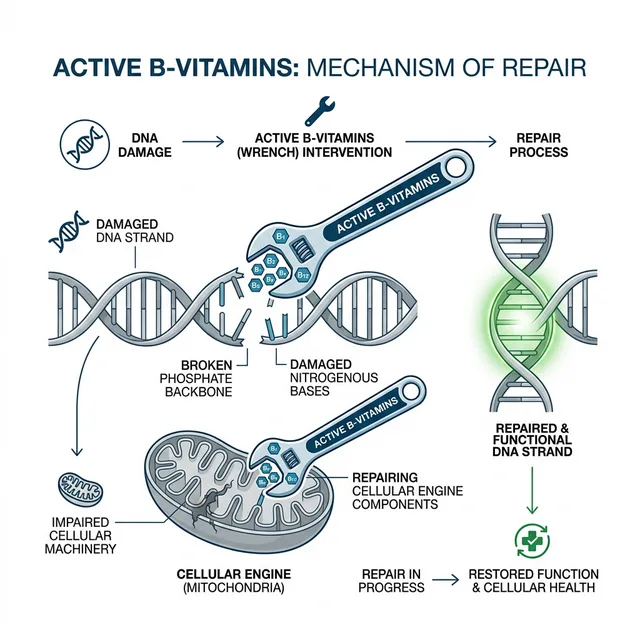
The clinical solution to this problem is surprisingly elegant. If the genetic enzyme (the factory) is broken, we simply give the body the finished product. We "bypass" the broken machinery entirely by supplementing with B-vitamins that are *already* methylated.
1. L-Methylfolate (Vitamin B9)
Throw away anything that says "Folic Acid." You must look for L-5-MTHF or L-Methylfolate. This is the biologically active form that crosses the blood-brain barrier immediately to turn on dopamine and serotonin production.
2. Methylcobalamin (Vitamin B12)
Avoid Cyanocobalamin (which literally leaves a microscopic cyanide molecule behind in your body that must be detoxified). Switch to Methylcobalamin or Adenosylcobalamin. These active forms instantly provide the methyl-groups necessary to drive mitochondrial energy production and clear out toxic homocysteine.
3. Check Your Homocysteine
A conventional doctor might tell you a homocysteine level of 14 umol/L is "fine." In functional longevity medicine, we know this is a massive cardiovascular threat. Functional approaches typically aim for homocysteine strictly between 6.0 and 8.0 umol/L.
Read next: Why Normal Blood Work Hides Metabolic Crises →
The Takeaway: Turn the Ignition On
If you have been chronically exhausted, don't just accept it as "getting older." You may simply have a hidden roadblock in your methylation cycle. By switching your neuro-metabolic support from cheap synthetics to bio-active, pre-methylated B-vitamins, you supply the spark plugs your body is starving for. You fix the ignition, and the engine starts running again.
An Educational Framework
- Test: Request a homocysteine blood test and MTHFR genetic panel. Homocysteine above 10 µmol/L suggests methylation dysfunction. If you carry the MTHFR C677T variant (40% of the population), standard folic acid may be harmful.
- Switch: Replace standard B-vitamins with methylated forms: Methylfolate (L-5-MTHF) 400-800mcg, Methylcobalamin (B12) 1000mcg, and Pyridoxal-5-Phosphate (active B6) 25mg. Take with food in the morning.
- Recheck: Retest homocysteine at 90 days. Target below 8 µmol/L. Most patients see improvement within 6-8 weeks. If resistant, add TMG (Trimethylglycine) 500mg as an alternative methyl donor.
Clinical Addendum
This content is for educational and informational purposes only. It is not intended as medical advice and should not replace consultation with a qualified healthcare professional. Always consult your physician before starting any new supplement, diet, or exercise programme, especially if you have known genetic mutations or cardiovascular conditions.