
By Dr. Gavin McAuley | EMPOWERVIDA
TL;DR
If you fall asleep fine but wake up abruptly at 3 AM with your mind racing, you are likely experiencing a neurological "excitatory" spike. Your brain lacks its natural brake pedal: Magnesium. Over 50% of adults are clinically deficient in this essential mineral. However, taking cheap pharmacy magnesium (like Magnesium Oxide) does nothing for the brain, as it cannot cross the blood-brain barrier. Discover why Magnesium L-Threonate is the clinical gold standard for resetting your sleep architecture and calming an overactive nervous system.
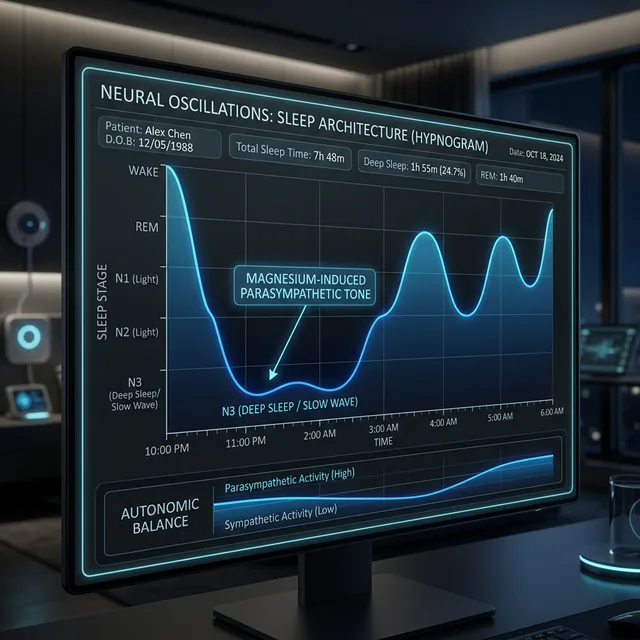
The Physician’s Perspective: The 3 AM Threat
In longevity medicine, one of the most prevalent—and metabolically debilitating—clinical presentations is the "3 AM Wake-Up."
Consider a common clinical scenario: An individual presents with profound exhaustion. They report falling asleep without difficulty around 10 PM. However, almost uniformly, they experience an abrupt awakening between 3:00 and 3:30 AM. They report an elevated heart rate, racing thoughts, and an inability to return to sleep for hours.
Patients frequently misattribute this to psychological stress and attempt meditation or breathing exercises with minimal success. However, the pathology is often fundamentally biochemical. The patient's nervous system has lost the capacity to regulate excitatory signals due to a profound deficiency in a critical neuro-modulatory mineral: Magnesium.
The Neurological Brake Pedal
To understand why you wake up panicked in the dark, you have to understand two competing neurochemicals in your brain: Glutamate and GABA.
Glutamate is your brain’s "gas pedal." It is highly excitatory, causing neurons to fire rapidly. GABA is the "brake pedal." It calms the system down, inducing relaxation and sleep.
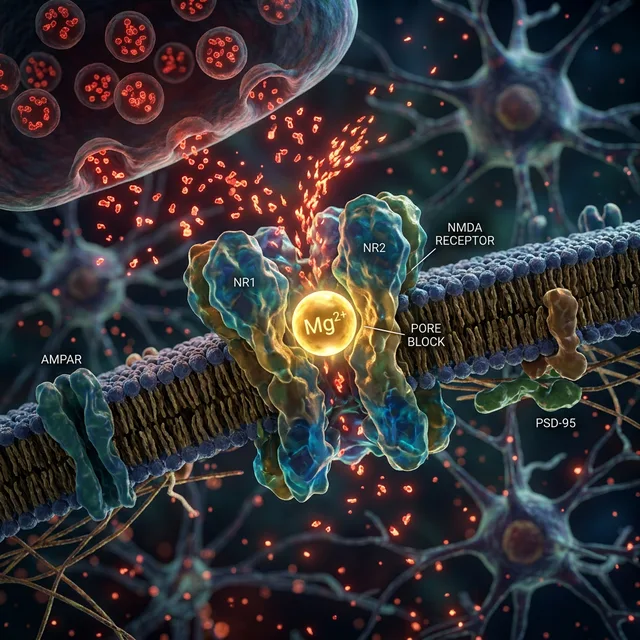
Magnesium sits physically inside the NMDA receptors of your neurons, acting as a natural gatekeeper. It literally blocks glutamate from over-stimulating the nerve. When you are deficient in magnesium, that gate is left wide open. Glutamate floods the system. The result? A perfectly quiet night is shattered by a sudden, uncontrolled spike in neural activity that jolts you awake at 3 AM.
By restoring brain magnesium levels, you put the "cap" back on the NMDA receptor. You restore the parasympathetic (rest and digest) tone.
The Great Magnesium "Scam"
Upon learning this, patients often self-prescribe over-the-counter magnesium supplements. Weeks later, they report continuing frustration as their sleep architecture remains fragmented and the 3 AM awakenings persist.
This is where bioavailability becomes critical. Standard pharmacy supplements almost exclusively use Magnesium Oxide.
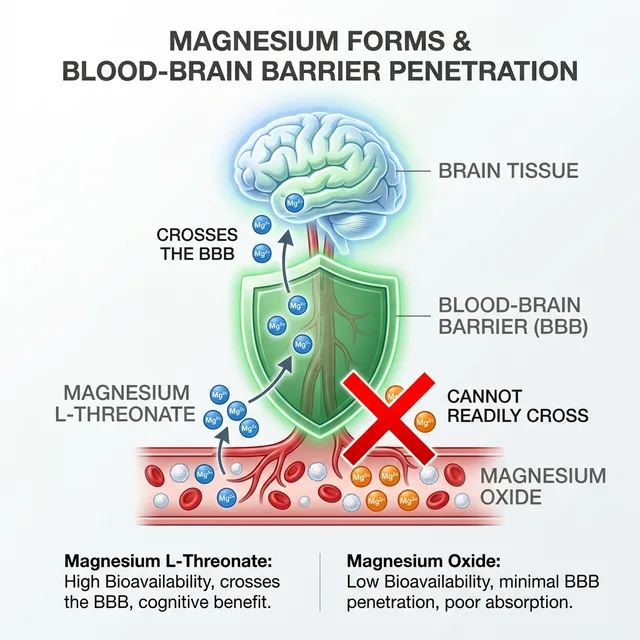
Magnesium Oxide has a truly dismal absorption rate—sometimes as low as 4%. Worse, it acts as an osmotic laxative, drawing water into your colon and causing digestive distress. Even if a tiny fraction makes it into your bloodstream, it cannot cross the blood-brain barrier. Taking Magnesium Oxide for sleep is essentially useless.
The Breakthrough: Magnesium L-Threonate
In 2010, researchers at MIT made a profound discovery. They successfully attached a magnesium molecule to Vitamin C metabolite called L-Threonate. This new compound—Magnesium L-Threonate—did something no other magnesium form could do.
It actively and predictably crossed the impenetrable blood-brain barrier, driving massive amounts of magnesium directly into the cerebrospinal fluid and the brain synapses. In clinical trials, it not only reversed sleep disturbances but actually reversed cognitive ageing by increasing synaptic density.
Read next: The Sun Phobia Trap (Why Your SPF is Costing You Your Mood) →
AN EDUCATIONAL FRAMEWORK
1. Purge the Oxide. Go to your supplement cabinet. If your magnesium or multivitamin lists "Magnesium Oxide," throw it in the trash. It is a gastrointestinal irritant, not a neurological tool.
2. Upgrade to L-Threonate or Bisglycinate. To eliminate the 3 AM wake-up, you need a form that reaches the brain. Take 1,000mg to 2,000mg of Magnesium L-Threonate approximately 60 minutes before bed. Alternatively, Magnesium Bisglycinate is highly absorbable and provides a strong calming effect.
View our Clinical-Grade Magnesium Stack Here →
3. Add the Precursor. Once you have stabilised your magnesium, ensure your brain has the "building blocks" for sleep by optimising Vitamin D levels.
Read our complete guide to Vitamin D testing →
Clinical Addendum: The Mitochondrial Connection
To fully understand the gravity of this protocol, we must look at the cellular level. Every biological function we've discussed ultimately relies on mitochondrial output. Mitochondria are the microscopic power plants inside your cells, responsible for converting the food you eat and the oxygen you breathe into ATP (Adenosine Triphosphate)—the universal energy currency of the human body.
When you experience symptoms like brain fog, chronic joint pain, or afternoon fatigue, traditional medicine often treats these as separate diseases. In longevity medicine, we view them as different downstream expressions of the exact same upstream problem: Sub-clinical Mitochondrial Dysfunction.
As we age, our mitochondria undergo structural decay. The phospholipid membranes that protect them become rigid, and they begin to leak free radicals (Reactive Oxygen Species) into the cell. This creates a state of chronic oxidative stress. Your immune system responds to this cellular damage by triggering systemic inflammation. This is the mechanism behind "Inflammaging"—the age-related increase in systemic inflammation that drives nearly every chronic disease.
Therefore, any protocol designed to optimize your healthspan must actively protect and regenerate these power plants. This is why the foundational pillars of our practice rely on specific interventions: Zone 2 Cardiovascular Training to force mitochondrial biogenesis (the creation of new mitochondria), Time-Restricted Eating to trigger mitophagy (the clearance of dead mitochondria), and targeted supplementation like NAD+ precursors and high-dose Omega-3s to provide the raw biological materials for cellular repair.
You cannot medicate your way out of mitochondrial dysfunction. You must systematically rebuild the architecture of your cells. This is the difference between simply masking symptoms and fundamentally improving the foundational markers of your biological age.
Clinical Addendum
This content is for educational and informational purposes only. It is not intended as medical advice and should not replace consultation with a qualified healthcare professional. If you suffer from chronic, severe insomnia, consult a sleep physician to rule out sleep apnea or other underlying conditions.