
By Dr. Gavin McAuley, Family Physician
TL;DR
Inflammation is the root of heart disease, Alzheimer's, and cancer. It damages DNA and mitochondria. Fix: Tiered antioxidant protocol. Tier 1: Liposomal Vitamin C + NAC (Glutathione precursor). Tier 2: Astaxanthin (brain/eye protection). Tier 3: Methylene Blue (mitochondrial rescue).
If you ask a cardiologist, a neurologist, and an oncologist what causes disease, they will use different jargon. But if you zoom in to the cellular level, they are all describing the same process: Chronic Inflammation.
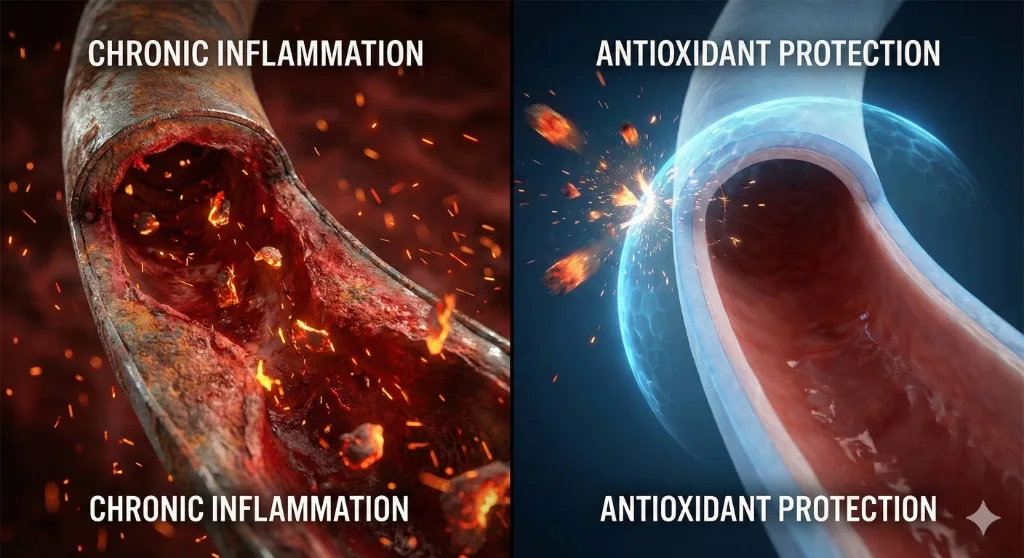
We used to think heart disease was just "clogged pipes" and Alzheimer's was just "bad luck." We now know better. Inflammation is the common denominator, a slow-burning fire that damages your DNA, stiffens your arteries, and suffocates your mitochondria.
The patients who haunt me most are the chronic inflammation ones. Rheumatoid arthritis. Inflammatory bowel disease. Young, fit people in their 30s and 40s whose immune systems have turned against them — and medicine's best answer is immunosuppression and symptom management. I have sat across from these patients and watched the hope drain from their faces when I explain that the drugs will manage the flare but will not address the root cause. That is what drove me to dig deeper. Because when you zoom into the cellular level, most of these conditions share the same driver: a fire that nobody is putting out.
One of the biggest drivers of this fire that most doctors will not discuss is the Western wheat-rich diet. We have been told for decades that "healthy whole grains" should be the foundation of our diet. But wheat is a double hit: a massive carbohydrate load that drives insulin resistance, plus inflammatory proteins (gliadin, wheat germ agglutinin) that increase gut permeability — so-called "leaky gut." When your intestinal barrier is compromised, bacterial endotoxins (LPS) enter the bloodstream and trigger a systemic immune response. This is not fringe science. The research on zonulin, the protein that regulates intestinal permeability, was published by Fasano et al. in prestigious gastroenterology journals. Yet most patients I see with chronic inflammation are still eating toast for breakfast, sandwiches for lunch, and pasta for dinner — and wondering why their CRP will not come down.
The Consequences: When the Fire Spreads
Inflammation is your immune system's response to injury. Acute inflammation (a bee sting) is good. Chronic inflammation (low-grade, systemic) is lethal. Here is how it drives the "Four Horsemen" of ageing:
- Heart Disease: Cholesterol itself isn't the enemy; oxidised cholesterol is. Inflammation damages the arterial wall, creating a crack where cholesterol gets stuck.
- Alzheimer’s Disease: The brain has its own immune cells called Microglia. When chronically inflamed, they go into overdrive, destroying healthy neurons. We call this "Type 3 Diabetes" or neuro-inflammation.
- Cancer: Chronic inflammation creates a "tumour microenvironment"—damageing DNA and suppressing the immune system's ability to kill mutant cells.
- Mitochondrial Dysfunction: Reactive Oxygen Species (ROS)—the sparks from the fire, physically damage the mitochondrial machinery, leading to fatigue and metabolic failure.
The Fire Extinguishers: A Physician’s Tier List
You cannot just "wish" inflammation away. You need chemical agents, Antioxidants, to neutralise the free radicals causing the damage.
Here is my ranked hierarchy of the most potent tools available, from "Daily Essentials" to "Heavy Artillery."
Tier 1: The Essentials (The First Line of Defence)
1. Vitamin C (The Scout)
What it is: The most famous water-soluble antioxidant.
The Reality: While essential, standard oral Vitamin C creates expensive urine. It is quickly excreted.
The Upgrade: Use Liposomal Vitamin C. The fat-encapsulated form bypasses digestion and enters cells directly. It neutralises free radicals in the blood before they reach your organs.
2. NAC (N-Acetyl Cysteine) -> Glutathione
The Mechanism: NAC is the precursor to Glutathione, the "Master Antioxidant." Your body produces Glutathione, but production drops with age.
Why it ranks high: You can't just eat Glutathione (it gets destroyed in the stomach). Taking NAC (600mg-1200mg) provides the building blocks your liver needs to restock its supplies. It is the ultimate detoxifier.
Tier 2: The Specialists (Targeted Defence)
3. Astaxanthin (The King of Carotenoids)
The Stat: In terms of raw power, Astaxanthin is often cited as being 6,000 times stronger than Vitamin C at quenching singlet oxygen.
The Benefit: It is one of the few antioxidants that can cross the blood-brain barrier and the blood-retinal barrier. It protects the brain and eyes specifically. It also acts as an "internal sunscreen" for your skin.
Tier 3: The Heavy Artillery (Advanced Protocols)
4. Methylene Blue (The Mitochondrial Rescuer)
What it is: Originally a dye, now repurposed as a metabolic enhancer.
The Mechanism: Methylene Blue is unique because it acts as an electron cycler. It steps in when your mitochondria are failing and helps pass electrons down the chain to create energy (ATP). It neutralises the specific free radicals (superoxide) that leak from damaged engines.
The Warning: Do not take this lightly. It interacts with SSRIs (antidepressants) and is dangerous for those with G6PD deficiency. Only use pharmaceutical-grade (USP), never the stuff meant for fish tanks.
The Takeaway
You are either fanning the flames (sugar, stress, seed oils) or putting them out. You do not need to take everything on this list. Start with the basics: A high-quality Liposomal C and NAC. If you are looking for cognitive protection, look into Astaxanthin.
Treat the fire before it burns down the house.
Inflammaging: Why Chronic Inflammation IS Ageing
Researchers have coined the term "inflammaging" to describe the phenomenon where chronic low-grade inflammation drives the ageing process itself. The mechanism centres on a molecule called NF-kB (Nuclear Factor kappa-light-chain-enhancer of activated B cells). NF-kB is the master switch for inflammation. When activated, it upregulates the production of inflammatory cytokines (IL-6, TNF-alpha, IL-1 beta) that directly damage mitochondrial DNA, shorten telomeres, and accelerate cellular senescence.
The critical insight is that NF-kB activation increases with age regardless of lifestyle, but lifestyle factors dramatically accelerate or decelerate this process. Obesity, sedentarism, chronic stress, poor sleep, and a diet high in refined sugar and seed oils all act as accelerants. Conversely, caloric restriction, regular exercise, cold exposure, and targeted antioxidant supplementation all suppress NF-kB activity. This is not speculative; a landmark 2019 paper in Nature Medicine by Furman et al. demonstrated that chronic, systemic inflammation is the single most consistent biomarker of accelerated biological ageing across all populations studied.
The Biomarker: hs-CRP Is Your Inflammation Score
If inflammation is the fire, then hs-CRP (high-sensitivity C-Reactive Protein) is the smoke alarm. This simple blood test, available from any GP, measures the level of systemic inflammation in your body. The liver produces CRP in direct response to IL-6, one of the key inflammatory cytokines. The interpretation is straightforward: below 1.0 mg/L is optimal; between 1.0 and 3.0 mg/L indicates moderate inflammation; above 3.0 mg/L is a significant risk factor for cardiovascular events and accelerated ageing. I test hs-CRP in every patient over 35, regardless of symptoms.
Educational Perspective
In clinical practice, it is common to see individuals presenting with a triad of symptoms: persistent joint stiffness, chronic fatigue, and metabolic resistance (stubborn visceral fat). Standard models often silo these symptoms into separate treatments—anti-inflammatories, antidepressants, and dietetics. However, comprehensive blood panels frequently reveal elevated hs-CRP and fasting insulin, pointing to chronic systemic inflammation as the unifying driver. Transitioning from a symptom-management approach to a foundational inflammatory protocol—eliminating processed seed oils, reducing refined carbohydrates, and ensuring adequate Omega-3 intake—often correlates with broad improvements across all these domains simultaneously.
(Disclaimer: I am a physician, but I am not your physician. Methylene Blue and high-dose antioxidants can interact with medications. Consult your doctor.)
The Foundation Reminder: Supplements are the fire extinguisher, not the fireproofing. The most potent anti-inflammatory intervention is lifestyle modification: eliminate industrial seed oils (canola, sunflower, soybean), reduce refined sugar intake to below 25g daily, sleep 7-9 hours consistently (sleep deprivation raises IL-6 and TNF-alpha by up to 40%), and walk 30 minutes daily. A Mediterranean-style diet rich in wild-caught fish, extra virgin olive oil, and colourful vegetables will reduce hs-CRP more reliably than any single supplement.
An Educational Framework
- Test: Request hs-CRP (high-sensitivity C-reactive protein) from your GP. This is the gold standard for measuring systemic inflammation. Optimal is below 1.0 mg/L. Above 3.0 mg/L is a red flag for cardiovascular and neurodegenerative risk.
- Extinguish: Start with the basics: 2g omega-3 fish oil (EPA+DHA), 1g Liposomal Vitamin C, and 600mg NAC daily. Eliminate seed oils and reduce refined sugar to below 25g/day. These changes alone can drop hs-CRP by 30-50% within 8 weeks.
- Retest: Recheck hs-CRP at 90 days. If still elevated, investigate deeper: consider an Omega-3 Index test, a comprehensive gut health panel (leaky gut drives systemic inflammation), and fasting insulin (insulin resistance is inherently pro-inflammatory).
Explore the Pillar Topic
This article belongs to our core medical pillar on The Longevity Master Guide. For a comprehensive, physician-guided deep dive into this topic, read the full foundational guide.
Clinical Addendum
Methylene Blue and high-dose antioxidants can interact with prescription medications, particularly SSRIs. This article is for educational purposes only. Always consult a qualified healthcare professional before initiating new supplementation protocols.
Related Reading
- seed oils and cell membrane damage — inflammation
- blood sugar spikes and metabolic damage — insulin resistance