
By Dr. Gavin McAuley | EMPOWERVIDA
TL;DR
You are literally built out of the fats you eat. Every one of your 30 trillion cells is surrounded by a lipid (fat) membrane. Historically, human cell walls were highly fluid, constructed from Omega-3 fats found in fish and wild game. Today, the modern diet is saturated with highly processed, oxidised Omega-6 seed oils. This shift has turned our cell membranes from a fluid "liquid crystal" into a stiff, rigid plastic. The result? Cellular suffocation, chronic inflammation, and unexplained fatigue. It is time for a cellular oil change.
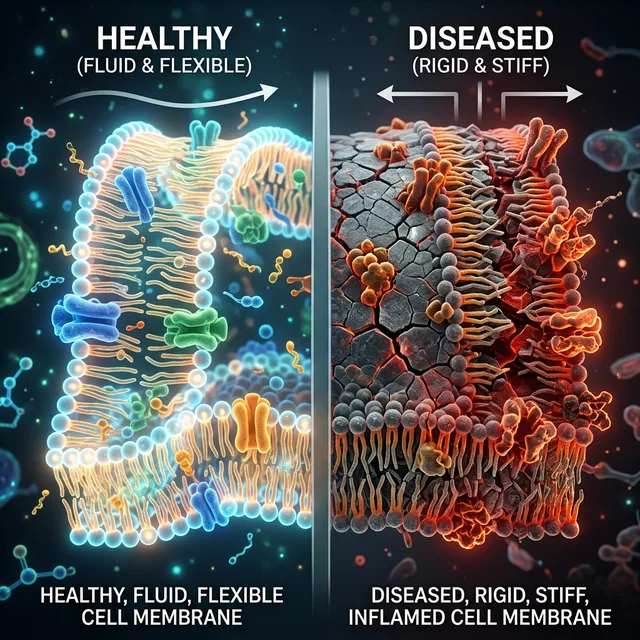
The Physician’s Note: The 30 Trillion Walls
When an individual presents complaining of deep, systemic fatigue, joint stiffness, and a pervasive "brain fog," they usually point to a lack of sleep or perhaps a vitamin deficiency. But as a physician focused on longevity and cellular medicine, my mind immediately goes to the architecture of their cells.
You have approximately 30 trillion cells in your body. Every single one of those cells—whether it is a neuron in your brain, a muscle fibre in your heart, or a skin cell on your face—is completely encased in a protective barrier called the "phospholipid bilayer."
This cellular "wall" is entirely constructed out of dietary fats. The saying "you are what you eat" is not a metaphor. It is biological reality. If you eat high-quality, stable fats, your cells are pliable and strong. If you eat highly processed, oxidised fats, your cells become stiff, rigid, and dysfunctional.
The Fluid Mosaic: How a Cell SHOULD Work
To understand the crisis, we have to look at how a healthy cell membrane operates. Biologists describe the ideal cell membrane as a "Fluid Mosaic."
It should not be a solid, impenetrable brick wall. It should be a dynamic, shimmering sea of liquid crystal. It needs to be fluid and flexible so that insulin receptors can slide along the surface, nutrients can effortlessly slip inside, and toxic metabolic exhaust can be flushed out.
What gives a cell membrane this incredible fluid property? **Omega-3 Fatty Acids**—specifically EPA and DHA. Because of their unique chemical structure (they have multiple double bonds that "kink" the molecule), Omega-3s cannot pack tightly together. When your cell walls are made of Omega-3s, they are beautifully flexible, allowing your cellular machinery to hum at peak efficiency.
The Great Oil Shift: The rise of Seed Oils
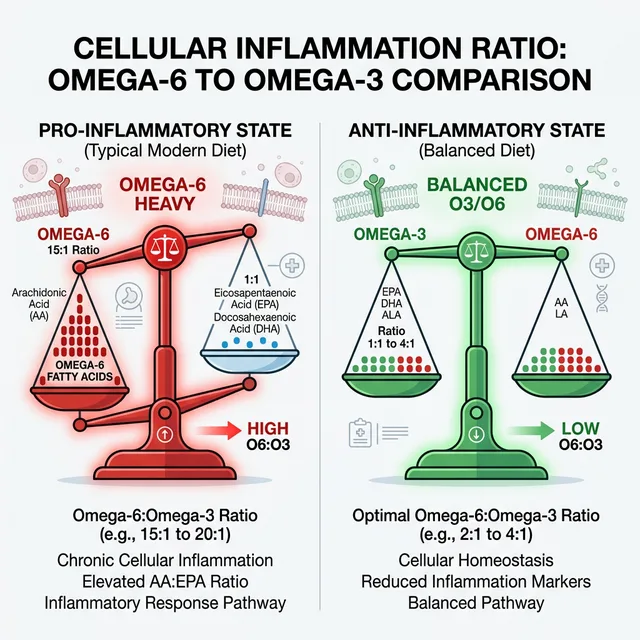
For 99% of human history, our ancestors ate a diet that naturally provided an Omega-6 to Omega-3 ratio of about **1:1** or **2:1**. We ate wild game, wild-caught fish, and foraged plants.
In the last 70 years, we radically altered the human food supply. We introduced highly processed, industrially extracted seed oils (Soybean oil, Corn oil, Canola, Sunflower, and Safflower oil). These oils are incredibly cheap to produce and are loaded with **Omega-6 Fatty Acids** (specifically Linoleic Acid).
Today, the average Westerner’s cellular Omega-6 to Omega-3 ratio sits somewhere between **15:1 and 25:1**. We have completely flooded our cellular architecture with the wrong type of building blocks.
And it is not just the oils. The entire Western dietary pattern is working against you. We have been told for decades that "healthy whole grains" should form the foundation of our diet — and most people dutifully eat toast for breakfast, a sandwich for lunch, and pasta for dinner. But wheat is a pro-inflammatory double hit: a massive carbohydrate load that spikes insulin, plus inflammatory proteins that damage the gut lining. You are simultaneously flooding your cells with the wrong fats and setting your gut on fire with every meal.
Clinical observation consistently demonstrates that transitioning away from a diet heavily reliant on processed grains and industrial seed oils towards one based on stable fats and high-quality proteins often correlates with significant reductions in systemic inflammatory markers. While a strict elimination diet is not necessary for every patient, it highlights an important clinical principle: many foods conventionally labeled as "heart healthy" may actually be primary drivers of metabolic and cellular distress.
The Rigidity Crisis: When Cells Become "Stiff"
When your body is starved of Omega-3s and flooded with Omega-6s, it is forced to build your cell walls out of whatever materials are available. Your body incorporates these highly unstable Omega-6 fats into the phospholipid bilayer.
The result is a biochemical disaster we refer to as **Lipid Peroxidation**.
Because these industrial seed oils were extracted under high heat and chemical pressure, they are often oxidised (damaged) before they even hit your plate. Once incorporated into your cells, they become rigid. The beautiful "Fluid Mosaic" is destroyed. Your cell membranes stiffen up like hard plastic.
When a cell membrane is stiff:
- Nutrients cannot get in. Your mitochondria slowly starve.
- Toxins cannot get out. Waste products build up inside the cell.
- Receptors fail. Insulin receptors embedded in the membrane become trapped in the rigid fat, leading directly to insulin resistance and metabolic dysfunction.
Furthermore, when these Omega-6 heavy membranes are damaged, they break down into highly inflammatory signalling molecules called eicosanoids. This is the physiological root of systemic, chronic inflammation—the driver of almost all age-related disease.
The Physician’s Protocol: The Cellular Oil Change
You cannot fix a stiff cell membrane overnight. The half-life of linoleic acid (Omega-6) in human adipose tissue is incredibly long—approximately 680 days. Ejecting these rancid fats takes time and deliberate action. But if you want to restore your energy and modulate inflammation, an "Oil Change" is non-negotiable.
1. Stop Pouring Sand in the Engine
The absolute first step is to ruthlessly eliminate industrial seed oils from your diet. Look at your pantry and throw out Soybean Oil, Corn Oil, Canola Oil, and Safflower oil. Replace them with stable, ancient fats: Extra Virgin Olive Oil, Avocado Oil, Grass-Fed Butter, and Tallow.
2. Flood the System with EPA and DHA
To push the ratio back to a healthy 2:1, you must aggressively supplement with high-quality Marine Omega-3s. Focus entirely on the active, bioavailable components: **EPA** (for systemic inflammation) and **DHA** (for brain and nerve tissue architecture). Guidelines typically suggest patients take at least 2,000mg to 3,000mg of combined EPA/DHA daily.
Read next: The Methylation Crisis (Why Your Cells Can't Turn Food Into Energy) →
3. The Phospholipid Upgrade (Astaxanthin/Krill)
Standard fish oil comes in "triglyceride" or "ethyl ester" forms. However, the fats in your cell membranes are specifically "phospholipids." When you consume Omega-3s BOUND to phospholipids (such as those found in high-grade Krill Oil), they bypass traditional digestion and seamlessly integrate straight into the cell membrane. Combining EPA/DHA with a fat-soluble antioxidant like **Astaxanthin** protects these fragile Omega-3s from oxidising in the bloodstream before they reach their destination.
The Takeaway: Build Better Walls
You can buy the most expensive longevity supplements in the world, but if your cell membranes are stiff, oxidised, and rigid, none of those nutrients will make it inside.
Stop eating the industrial oils that make your cells stiff. Commit to a clinical-grade Omega-3 "Oil Change." Restore the fluid mosaic, and you will restore the very foundation of your cellular energy infrastructure.
An Educational Framework
- Eliminate: Remove all industrial seed oils from your kitchen: canola, sunflower, safflower, soybean, and corn oil. Replace with extra virgin olive oil (cooking below smoke point), coconut oil (high heat), and grass-fed butter or ghee.
- Rebuild: Supplement with high-quality Omega-3 fish oil daily (EPA + DHA combined). Look for triglyceride form, third-party tested for heavy metals.
- Verify: Request an Omega-3 Index blood test. Target an optimal index above 8% to ensure adequate cellular integration.
Clinical Addendum
High-dose Omega-3 supplementation can alter blood viscosity. Patients currently prescribed anticoagulant medications (e.g., Warfarin, Apixaban) must consult their primary care physician prior to initiating high-dose EPA/DHA protocols.